Executive summary
Secondhand commerce was still built for desktop. As founding product design director, the work rebuilt the model from scratch — mobile-native, low-friction, built around local trust.
Result: 1M+ users. €1.23M raised across two rounds. Acquired. Apple "Best Apps Germany" 2012.
Key outcomes
- Defined a mobile-first marketplace model tuned to local discovery and low-friction listing
- Shipped a coherent product language across identity, navigation, and transaction trust
- Validated demand through rapid iteration with measurable growth in active buyers and sellers
- Earned sustained recognition from Apple, Lovie, Lead Award, and IPDC for product craft
Experience clarity vs. legacy classifieds
Directional product and market signal (concept → scale)
Desktop listing drag
Wrapper UX ceiling
Trust & identity lock
Local discovery loop
Weak experience clarity·Strong experience clarity
Light legacy burden
Heavy legacy classifieds
Directional marketplace cohorts · product synthesis · concept → scale benchmark
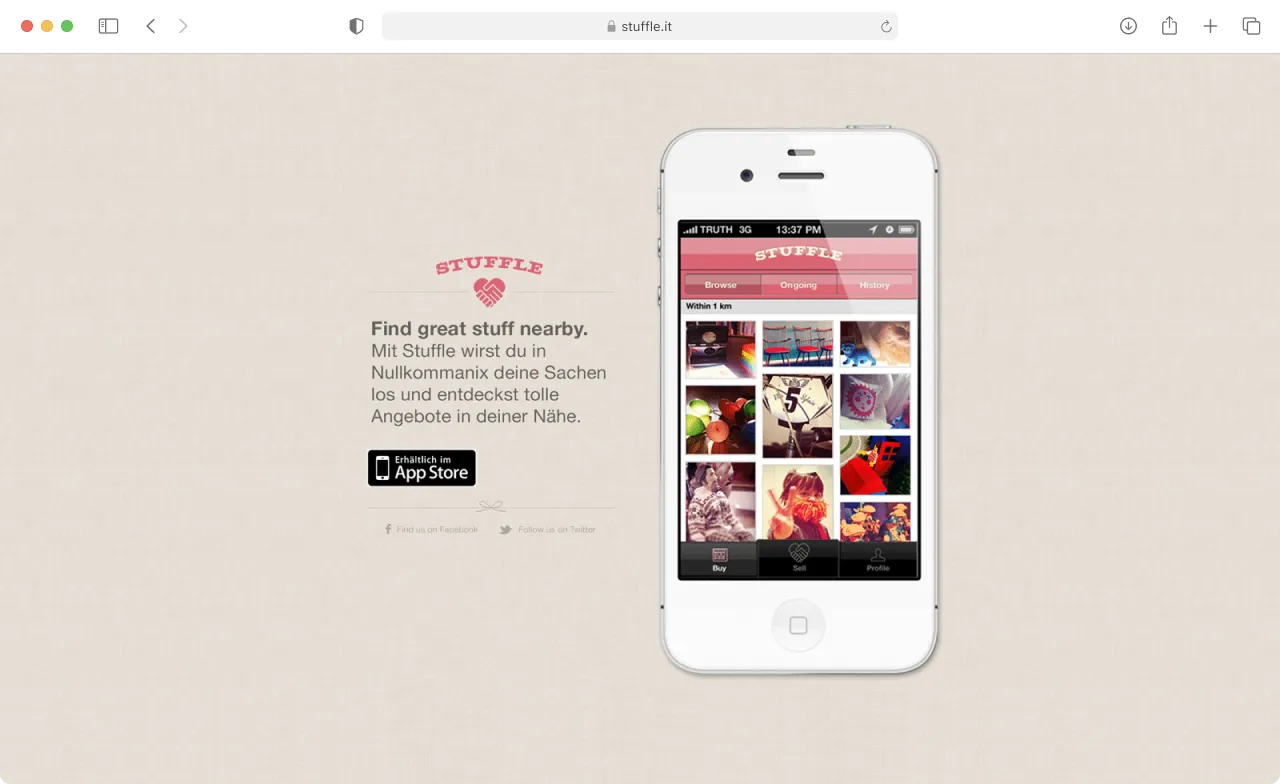
Stuffle
Digital Pioneers & Widget Labs — hyper-local secondhand commerce, Germany
Key metrics

1M+
Peak users on the platform
€1.23M
Funding raised across two investment rounds

2012
Year highlighted in Apple “Best Apps Germany” recognition

4+
Major international product and design honors
- Client
- Digital Pioneers & Widget Labs
- Role
- Product Design & Marketplace Strategy
- Timeline
- 2015–2018
- Industry
- Marketplace / Commerce
- System
- Trust
- Domain
- Marketplace
- Design Lever
- Trust
- Primary Outcome
- Scale
- Framework
- Marketplace Trust System
Challenge
Secondhand commerce in Germany was dominated by horizontal classifieds built for desktop — broad reach, low trust, high friction. Listings required effort; buyer-seller trust depended on platform policy pages rather than product-visible reputation signals. Mobile adoption was accelerating, but incumbent players treated mobile as a responsive afterthought, not an architecture decision. Digital Pioneers and Widget Labs saw an opportunity in hyper-local exchange — neighbours trading with neighbours — but scaling required trust as a system property embedded in every transaction flow, not a legal disclaimer. The business problem was categorical: could a mobile-native marketplace win against established horizontal players by designing trust, friction reduction, and local discovery into the product architecture from day one?
Solution
As founding Product Design Director, I architected Stuffle as a Marketplace Trust System — mobile-first by design, built around local discovery, low-friction listing, and reputation signals visible throughout the transaction journey. My role spanned product vision, interaction design, and marketplace mechanics: I defined the mobile-first information architecture, designed identity and navigation patterns that made trust legible, and built community mechanics that encouraged repeat exchange within geographic proximity. I shipped a coherent product language across onboarding, listing creation, buyer discovery, and transaction completion — each touchpoint reinforcing that Stuffle was a local community, not a classifieds clone. Rapid iteration validated demand through measurable growth in active buyers and sellers; design craft earned sustained recognition from Apple, Lovie, Lead Award, and IPDC.
Context
Germany's classifieds market in the early 2010s was consolidating around horizontal platforms with network effects incumbents enjoyed. Startups competing on features alone faced cold-start problems on both supply and demand sides. Mobile behaviour was shifting — users expected camera-first listing, push notifications for local matches, and social identity layered onto transactions. Digital Pioneers and Widget Labs operated with venture backing and a narrow window to demonstrate product-market fit before incumbents could respond with mobile offerings. Stakeholders included founders, investors (including High-Tech Gründerfonds), and a design team building for recognition in a market that equated "marketplace" with eBay Kleinanzeigen. Regulatory and trust concerns around peer-to-peer commerce required product-visible safety, not just terms of service.
Evidence
Stuffle reached 1M+ users at peak adoption. The company raised €1.23M across two investment rounds and achieved a successful exit. Apple recognized Stuffle in "Best Apps Germany" 2012; additional honours included Lovie, Lead Award, and IPDC for product craft. Andreas Quauke of High-Tech Gründerfonds cited the combination of innovation, ease of use, social interaction, and real user value as the basis for investment — validating the trust-and-friction thesis. Growth metrics tracked active buyers and sellers, listing completion rates, and repeat transaction rates within geographic clusters — evidence that local trust architecture scaled beyond early adopters.
Framework
Marketplace Trust System
The Marketplace Trust System channels user profiles, listings, and community signals through a trust architecture — producing transaction volume, marketplace scale, and community growth. Stuffle demonstrated that hyper-local secondhand commerce wins when trust is the product mechanism, not the legal framework around it.
Inputs
Core System
Trust architecture combining mobile-first design, reputation signals, and friction reduction
Outputs
Principles
- Trust in marketplaces is a system design problem — policy pages manage liability; product signals manage behaviour.
- Mobile-first is an architecture decision made on day one, not a responsive CSS pass applied after desktop launch.
- Local commerce scales when reputation signals are designed into the transaction flow — not bolted on after the first fraud incident.
- Category re-segmentation requires product coherence across identity, discovery, and transaction — one weak link reverts users to incumbents.
Research context
Informed by two-sided marketplace dynamics, trust and reputation system design, and mobile-first product architecture — applied in a market where horizontal incumbents owned supply and demand aggregation but underinvested in local community mechanics.