Stuffle
Digital Pioneers — hyper-local secondhand commerce, Germany
- Client
- Digital Pioneers
- Role
- Product Design & Marketplace Strategy
- Timeline
- 2015–2018
- Industry
- Marketplace / Commerce
- System
- Trust
- Domain
- Marketplace
- Design Lever
- Trust
- Primary Outcome
- Scale
- Framework
- Marketplace Trust System
Executive summary
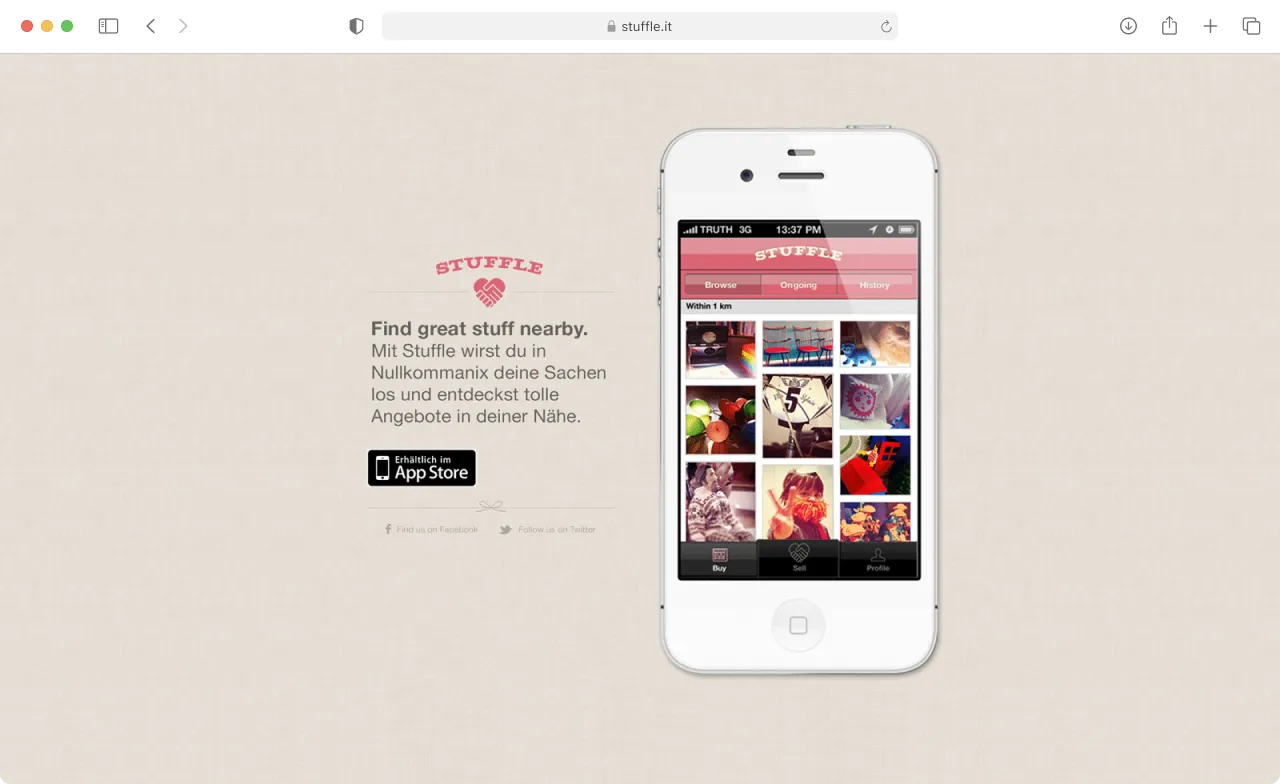
Secondhand commerce was still built for desktop. As founding product design director, the work rebuilt the model from scratch — mobile-native, low-friction, built around local trust.
Result: 1M+ users. €1.23M raised across two rounds. Acquired. Apple "Best Apps Germany" 2012.
Key outcomes
- Defined a mobile-first marketplace model tuned to local discovery and low-friction listing
- Shipped a coherent product language across identity, navigation, and transaction trust
- Validated demand through rapid iteration with measurable growth in active buyers and sellers
- Earned sustained recognition from Apple, Lovie, Lead Award, and IPDC for product craft
Principles
- Trust in marketplaces is a system design problem — policy pages manage liability; product signals manage behaviour.
- Mobile-first is an architecture decision made on day one, not a responsive CSS pass applied after desktop launch.
- Local commerce scales when reputation signals are designed into the transaction flow — not bolted on after the first fraud incident.
- Category re-segmentation requires product coherence across identity, discovery, and transaction — one weak link reverts users to incumbents.
Key metrics
- Peak users on the platform
- 1M+
- Funding raised across two investment rounds
- €1.23M
- Year highlighted in Apple “Best Apps Germany” recognition
- 2012
- Major international product and design honors
- 4+
 1M+
1M+ €1.23M
 2012
2012 4+
4+Framework
Marketplace Trust System
The Marketplace Trust System channels user profiles, listings, and community signals through a trust architecture — producing transaction volume, marketplace scale, and community growth. Stuffle demonstrated that hyper-local secondhand commerce wins when trust is the product mechanism, not the legal framework around it.
Inputs
Core System
Trust architecture combining mobile-first design, reputation signals, and friction reduction
Outputs
Experience clarity vs. legacy classifieds
Directional product and market signal (concept → scale)
Desktop listing drag
Wrapper UX ceiling
Trust & identity lock
Local discovery loop
Weak experience clarity·Strong experience clarity
Light legacy burden
Heavy legacy classifieds
Directional marketplace cohorts · product synthesis · concept → scale benchmark