Innovation
I Built Websites in 1996. AI Feels the Same.
Last Tuesday, I was in Berlin and had the pleasure of delivering a keynote to one of the many engineering company’s focused on supplying solutions to the automotive industry.
What was personally interesting with this organization was that I was told that they had everything they need to solve climate change (the tools, the people and the culture).
So, why haven‘t they done it?
The challenge they have is – not only have they been supplying to an industry that has become less relevant – they are also caught in the next evolution in technology; aka artificial intelligence (AI).
Going into details of the decline of the automotive industry is beyond the scope of this article; the bigger picture is how AI is transforming organizations. And more relevant to most of you: is AI solving or creating more problems?
Personally, I feel like today feels a lot like 1995.
Back then the web was still young, undefined, and full of possibility. There was no playbook. We were learning by doing, experimenting with what the internet, design, and all of it could and would become.
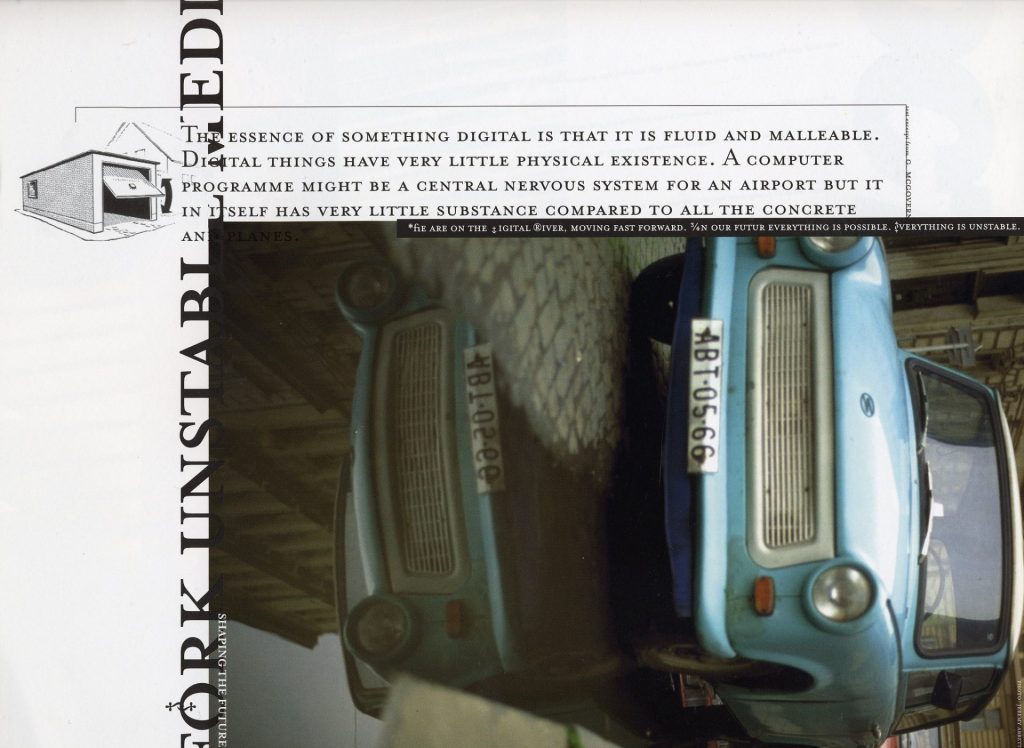
A year later in 1996, it was with this mindset that I co-founded Fork Unstable Media.
At Fork we were doing things from our own point-of-view – not always the correct way, not on a competence that was not yet apparent, not on a technical proficiency that was still being defined, not on being safe by staying in the middle.
That’s how AI feels today.
Not as a finished product. Not as a settled industry. But as a new tool: not intelligent, not conscious, not a meaning maker, but extremely capable at pattern recognition and task execution.
If there‘ s one thing I learned about building things from the early Web days it was that new technologies start as infrastructure before they become part of culture. And the biggest opportunities appear before the rules are clear; that’s where imagination matters most.
Today, the real advantage is not speed alone.
It’s taste, judgment, and direction. In mid-90s, the things that were sought-out and shared were built by those not evaluating but building releasing it to the world. Things like jodi.org and fork.de among others.
At first, it was only a small percentage of technically literate people that built websites but then, through WYSIWYG editors like Macromedia Dreamweaver, next were people that were motivated enough to want to build and then later platforms like GeoCities made it available to everyone.
Consumer AI is still young. If I compare it to the Internet era it feels like the AOL is at it‘s peak, with everyone understanding what e-mail was and most having even written one.
We’re not in the hype phase of AI, we’re in the 1995 phase: the winners aren’t decided yet, and whoever acts now leapfrogs an entire generation.
I have a name for this stretch now: the Pre-Rules Window. It’s not the hype phase and it’s not the settled-industry phase — it’s the specific stretch in between, where the rules haven’t been written yet and the people who act anyway are the ones who end up writing them. I lived through it once already, in ’96. We’re standing in another one right now.
Which brings me back to the question, “Why haven‘t they done it yet?”
If you’re as uncomfortably excited as I am, you know that there are no perfect decisions, just decisions you learn from, and the courage to keep adjusting as you go.
The real risk is not in being wrong, but in doing nothing at all.
Thirty years after founding Fork, I’m reminded of the same lesson: the most important moments in technology are also the most human ones.
AI is not just another tool.
It is a shift in how things are being done.
And we are still early.
So, where is your team right now – 1995, or still waiting? Let’s talk for 15 minutes, I’ll show you the first concrete step.
Verwandtes System
Marketplace Trust SystemVerwandte Fallstudie
StuffleNext up
- June 17th, 2026
Der 80-Jahres-Moment
Alle 80 Jahre bricht der Boden unter der alten Welt weg. Dampf. Stahl. Computer. Und jetzt — KI und Energie. Was sich gerade verändert, ist kein Hype-Zyklus. Es ist ein Strukturbruch. Die meisten werden es erst merken, wenn er vorbei ist.
- June 12th, 2019
Mind the Progress
Hamburg News talks to designer Jeremy Abbett about the power of creativity
- April 4th, 2019
How to Nurture Creative Bravery and Bold Ideas
Creativity is at the heart of mankind’s greatest inventions and novel ideas. It’s often touted as one of the most desirable attributes in employees, and yet