Quality Is Not a Moat
Business · 7 min read
In high school, Germany was a foreign place where quality things came from.
In ninth-grade, I was living in Round Rock, Texas. A friend of mine at the time had a German mother. I used to go over to his house and she would give us Haribo gummi bears produced in Germany — this was before you could find them at every checkout aisle in America. They tasted different from the waxy domestic knock-offs. More fruit, cleaner, somehow more deliberate. I didn’t have the vocabulary for it then, but what I understood was: German things are made differently.
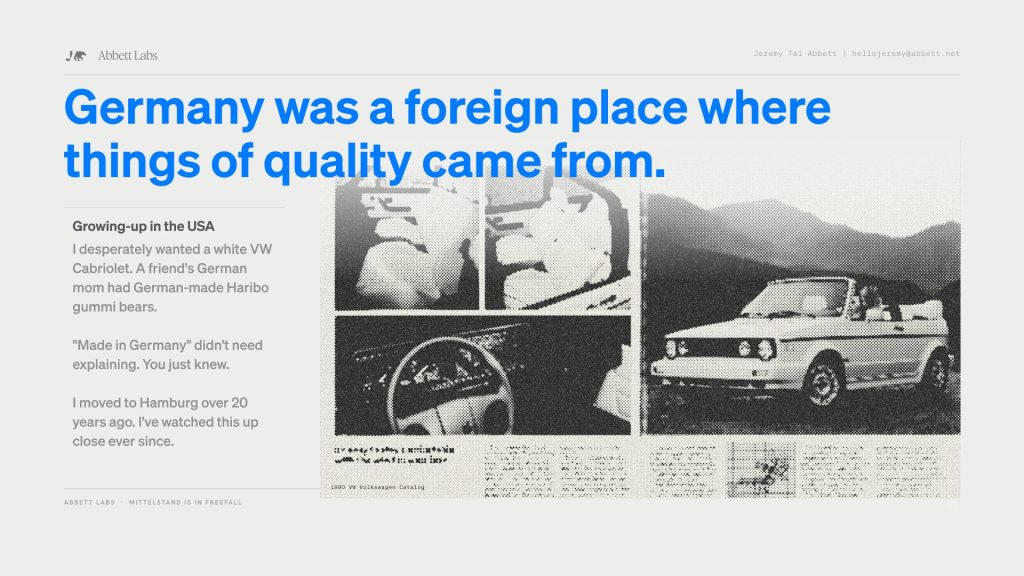
In my second junior year of high-school, I had moved to Edina, Minnesota. I desperately wanted a white VW Cabriolet. Not a BMW, not a Mercedes — a Cabriolet. Soft top, clean lines, the kind of car that communicated something specific about the person driving it. Made in Germany. Even that phrase had a particular register, the way “Swiss-made” does on a watch face. It didn’t need explaining. You just knew.
I moved to Hamburg over twenty years ago. And here’s what I found when I arrived: all of it was real. The care, the precision, the quiet insistence on doing things right. The Mittelstand — Germany’s tier of mid-sized, specialized manufacturers — had spent generations building exactly what that label promised. It was never marketing. It was identity.
That’s also exactly the problem.
Germany has roughly 1,500 companies that rank #1 or #2 globally in their niche. You’ve never heard of most of them. That was supposed to be the point.
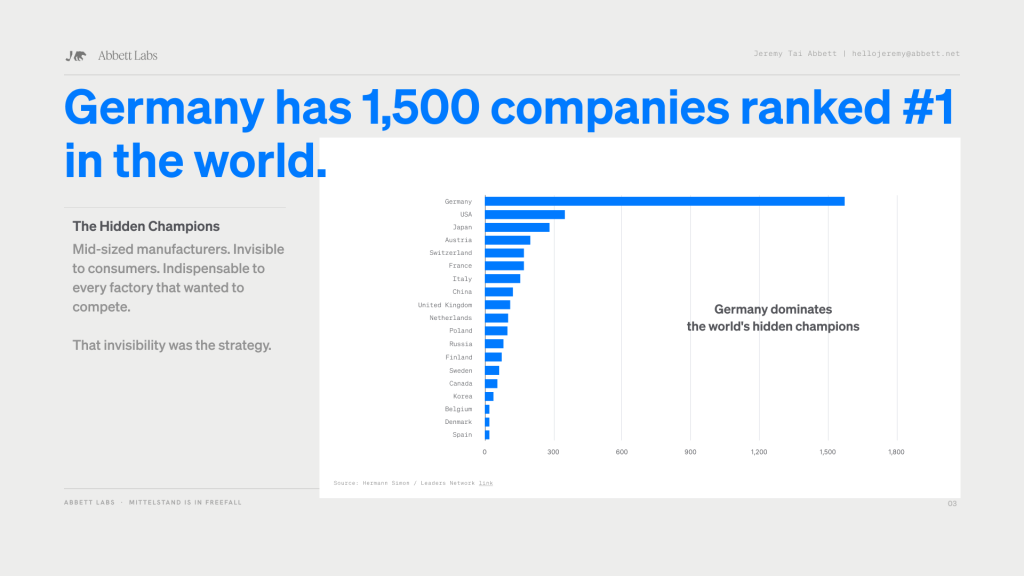
The Mittelstand — Germany’s dense tier of mid-sized, specialized manufacturers — built the most enviable industrial position in modern history by being quietly, ruthlessly excellent at things nobody else bothered to become excellent at. Heating elements for industrial presses. Precision coatings. Machine tools so specialized they have no obvious substitute. These “hidden champions” powered the German economic miracle from behind the scenes, invisible to consumers but indispensable to every factory that wanted to compete.
I live in Hamburg. I’ve watched this model at close range for thirty years. And I’ve watched, over the past eighteen months, as something that felt permanent start to come apart.
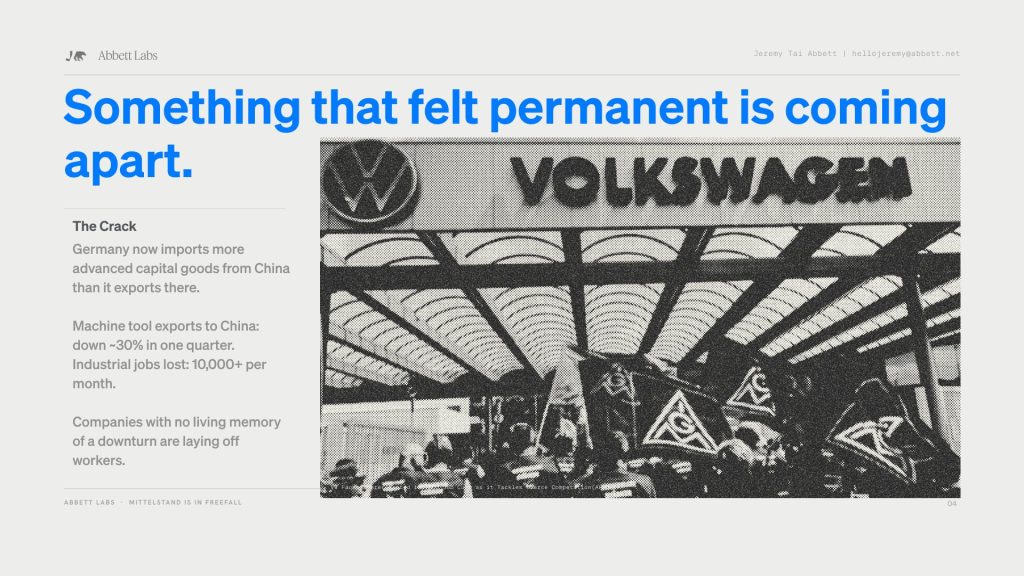
Germany now imports more advanced capital goods from China than it exports there. Machine tool exports to China dropped roughly a third in a single quarter. Companies that have never known a downturn are laying off workers in towns that have never needed to think about industrial decline. China’s government-backed “10,000 Little Giants” initiative — an explicit, funded program to build Chinese versions of German hidden champions, niche by niche — is closing quality gaps that the Mittelstand spent generations building.
The panic is real. But I think most of the diagnoses are wrong.
The thing Germany got confused
The conventional explanation is that China got cheaper and the Mittelstand got too expensive. Energy prices, subsidies, labor costs — all true, all contributing. But there’s a more uncomfortable explanation that nobody in the trade associations wants to say out loud:
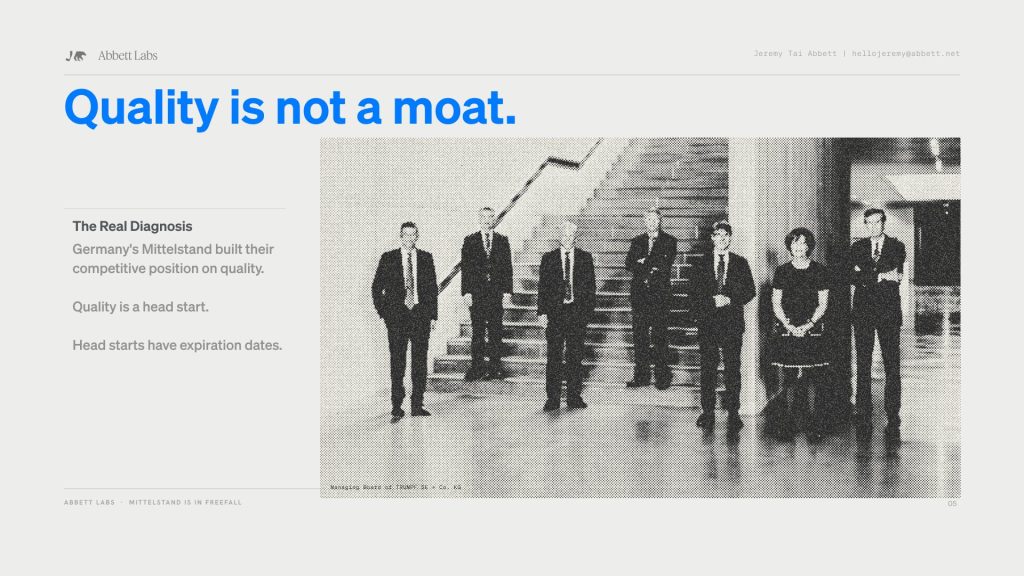
Germany’s Mittelstand built their moat on quality. Quality is not a moat.
Quality is a head start. Head starts have expiration dates.
What the Mittelstand actually had — what felt like a moat — was a combination of things: deep application knowledge accumulated over decades, customer relationships that were embedded into factory floors, and a reputation that made buyers reluctant to risk an inferior alternative when the stakes were high. That’s not quality. That’s positioning. And positioning requires active, deliberate maintenance. It isn’t preserved by the act of continuing to do excellent work.
The hidden champion thesis — articulated by Hermann Simon, whose research produced that chart — was always half description, half strategy. The description part: these firms are world-class in narrow niches. The strategy part, which got undersold: they have to actively stay hidden from competition while staying essential to customers. The second half requires more than craftsmanship. It requires knowing what you’re competing on beyond the spec sheet.
Most of these firms never did that work. They didn’t need to. Until now they did.
China didn’t beat Germany at manufacturing. It copied Germany’s playbook.
This is the part that should unsettle anyone running a knowledge business, a consultancy, or any firm whose pitch starts with “we do exceptional work.”
China’s 10,000 Little Giants program isn’t an industrial subsidy scheme in the conventional sense. It’s a positioning strategy executed at government scale. The Chinese government looked at the competitive map, identified the exact niches where German hidden champions sat, and systematically funded domestic firms to occupy those positions — not just with cheaper production, but with integrated ecosystems that are now selling the entire factory floor from a single vendor.
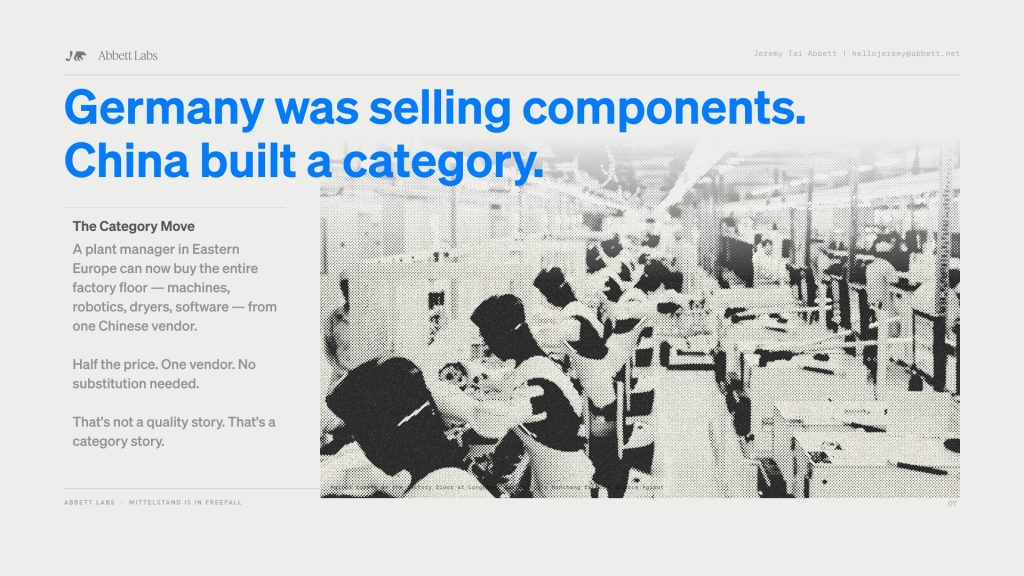
When a plant manager in Eastern Europe or South America is setting up a new facility, they can now source injection machines, robotic arms, dryers, and cloud management software from one unified Chinese supplier at half the price. That’s not a quality story. That’s a category story. China built a new category: the complete affordable factory ecosystem. Germany was still competing as a premium component vendor.
The Mittelstand didn’t lose to a better mousetrap. They lost to a different game.
The lesson is not about Germany
I’m not writing this as industrial analysis. I’m writing it as a warning for every expert, consultant, and firm I know — including myself — whose competitive story is some version of: we’re really good at what we do.
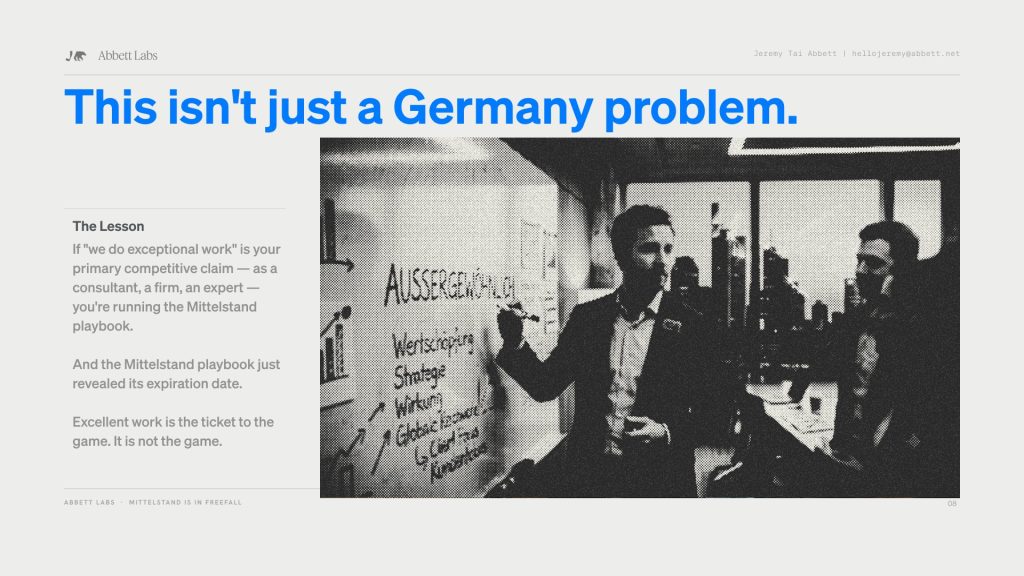
Here’s the uncomfortable truth: if “exceptional quality” is your primary competitive claim, you are running the Mittelstand playbook. And the Mittelstand playbook just revealed its expiration date.
“Exceptional work” is the ticket to the game. It is not the game.
The firms I’ve watched thrive across multiple inflection points — and I’ve lived through three now, from the birth of the digital agency through the platform era at Google and ThoughtWorks to the current AI inflection — share one thing that isn’t craft. It’s the ability to own a category in someone’s mind. To introduce vocabulary that clients and peers adopt and repeat. To create a framing so specific to their point of view that copying it requires becoming them.
That’s hard to replicate. Excellent execution is not.
The most common thing I see from consultants and advisory firms right now is a version of the hidden champion trap: they have a genuine, hard-won expertise advantage, and they’re protecting it by going deeper into the same niche rather than asking the harder question: what do we own in our clients’ minds that has nothing to do with how good we are?
The part I keep thinking about
Patric Burkhart runs Aura, a 115-person German machinery manufacturer. He told the WSJ that 20% of his production has moved to China, and that could become 70% if nothing changes. He described it as “a historic change that brings the whole society under pressure.”
What strikes me is the tense. “If nothing changes.” He’s still describing this as a condition that could be reversed by external forces — policy, trade cases, European regulation. Those things may help. But the deeper change needed isn’t in Brussels. It’s in how Aura, and every firm like it, answers the question: what do we own that China can’t acquire through scale and subsidy?
If the honest answer is “our quality,” they need a new answer.
I left Springer & Jacoby in 1995, before the dot com hype. I built Fork Unstable Media on the thesis that the moat wasn’t beautiful work — it was building things clients didn’t know to ask for, before they knew to ask. Three of those ended up in SF MoMA’s permanent collection. Two of those weren’t commissioned. They were owned.
That’s what I mean. The moat is what you build when no one is watching. Not a better version of what the market is already buying.
–
Source: WSJ, “China Is Devastating the Last Stronghold of German Industry” (July 3, 2026). Data points in article sourced directly from that piece.
Related system
Innovation Operating SystemRelated case study
I8N for Gruner + JahrNext up
- July 15th, 2026
You’re not buying intelligence. You’re paying for the right to teach it.
The product isn’t the answer you get. It’s the data you hand over to get it. Every workflow, every strategy memo, every client signal you route through an external AI model is curriculum — and once the lab has internalized your specificity at scale, you're buying back capability you effectively taught it. I've watched this platform playbook run before. Here's what to do about it.
- June 25th, 2026
I Built Websites in 1996. AI Feels the Same.
Last Tuesday, I was in Berlin and had the pleasure of delivering a keynote to one of the many engineering company’s focused on supplying solutions to the
- June 17th, 2026
Der 80-Jahres-Moment
Alle 80 Jahre bricht der Boden unter der alten Welt weg. Dampf. Stahl. Computer. Und jetzt — KI und Energie. Was sich gerade verändert, ist kein Hype-Zyklus. Es ist ein Strukturbruch. Die meisten werden es erst merken, wenn er vorbei ist.